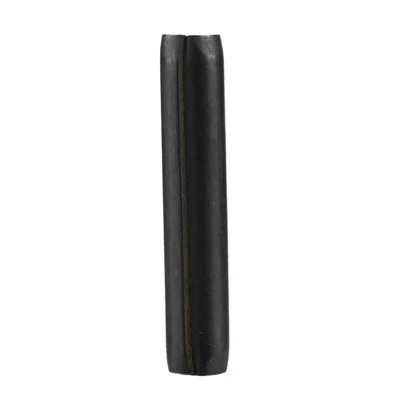

ISO 8748 Heavy Duty Coiled Spring Pins – Technical Specifications
| Item | Specification |
|---|---|
| Standard Title | Spring‑type straight pins – Coiled, heavy duty |
| Nominal Diameter d Range | φ1.5 ~ φ20 (1.5,2,2.5,3,3.5,4,5,6,8,10,12,14,16,20) |
| Diameter before mounting | Max:1.71‑21;Min:1.61‑20.4 |
| Wall thickness s | 0.17 ~ 2.2 |
| Minimum Double Shear Strength | Steel/Martensitic SS:1.9‑340 kNAustenitic SS:1.45‑91 kN |
| Material Types | Steel (St), Austenitic stainless steel (A), Martensitic stainless steel (C) |
| Steel (St) | Two chemical options; Hardened & tempered: 420‑545 HV |
| Austenitic Stainless Steel (A) | Cold‑worked; Cr16‑20, Ni6‑12 |
| Martensitic Stainless Steel (C) | Hardened & tempered: 460‑560 HV; Cr11.5‑14 |
| Surface Condition | Steel: natural finish, anti‑hydrogen‑embrittlement for plating(ISO 4042)Stainless steel: natural finish |
| Application | Mating hole tolerance H12 |
| Shear Test Standard | ISO 8749 |
| Length Tolerance | L≤10: ±0.25;10<L≤50: ±0.5;50<L≤200: ±0.75 |
- Higher Radial Load Resistance
The heavier wall section of ISO 8748 pins provides higher resistance to radial deformation under shear and transverse loading, making them suitable for joints exposed to higher mechanical loads.
- Continuous Hole-Wall Contact
After installation, the coiled section expands against the hole wall to maintain distributed radial contact. This helps transfer load through the joint rather than concentrating stress at a single contact point.
- Resistance to Vibration and Shock
The elastic action of the coiled cross-section allows the pin to accommodate small changes in joint loading caused by vibration, impact, and repeated movement while maintaining retention in the hole.
- Secure Retention Under Repeated Loading
The controlled radial spring force helps maintain the interference fit between the pin and mating hole, reducing the risk of pin migration or loosening during cyclic operation.

Dimensional Tolerance & Manufacturing Accuracy

- Controlled Pin Diameter
Pin diameter is controlled to achieve the specified interference relationship with the mating hole. Consistent diameter is critical for predictable insertion force and installed retention.
- Free Diameter & Compression Control
The free diameter is monitored to control how the coiled pin compresses during installation. This helps maintain consistent radial force after the pin is seated in the hole.
- Length and End Condition
Pin length is controlled according to the specified tolerance, while the cut ends are processed to provide consistent end geometry and minimize installation interference caused by burrs or irregular edges.
- Production Batch Consistency
Forming, heat treatment, sizing, and final inspection are controlled to minimize dimensional variation between production batches, supporting repeatable fit and assembly performance in volume production.
ISO 8748 Heavy Duty Coiled Spring Pins Manufacturing Process
From precision coiling to controlled heat treatment and surface finishing, every production stage is managed to deliver consistent fit, strength, and batch-to-batch performance.

Coiling
Spring steel strip is formed into a multi-layer cylindrical profile under controlled forming conditions. Precise control of strip tension, forming accuracy, and coil geometry helps maintain consistent free diameter and dimensional stability throughout production.

Heat Treatment
Heat treatment is applied to achieve the required balance of hardness, elasticity, and fatigue performance. Process parameters are controlled according to the selected material and specification to ensure stable mechanical properties across production batches.

Surface Treatment
Pins can be supplied with protective oil, zinc plating, phosphating, or other specified finishes according to application requirements. Coated parts can undergo hydrogen embrittlement relief where applicable to improve coating reliability and service performance.
Custom ISO 8748 Heavy Duty Coiled Spring Pins
Manufactured to match your specific assembly, performance, and procurement requirements, with custom options available for OEM and high-volume applications.
Custom Dimensions & Tolerances
Diameter, length, free diameter, and dimensional tolerances can be manufactured according to your drawing or specified mating-hole requirements.
Material & Mechanical Properties
Select spring steel or stainless steel grades with controlled heat treatment and hardness to meet specific load, elasticity, and fatigue requirements.
Surface Treatment Options
Available with protective oil, zinc plating, phosphating, black oxide, or other specified finishes according to corrosion protection and application requirements.
Drawing-Based OEM Production
Production can be developed from customer drawings, samples, or technical specifications, with controlled batch consistency for prototype and volume orders.
Inspection & Testing for ISO 8748 Heavy Duty Coiled Spring Pins
Multi-stage inspection verifies dimensional accuracy, forming quality, heat-treated properties, and surface performance to ensure consistent quality across production batches.

Material & Dimensional Verification
Incoming spring steel is verified for material composition and dimensional conformity before production. Digital micrometers, calipers, automatic optical measurement, and Keyence inspection systems are used to control critical dimensions such as pin diameter, length, and formed geometry.

Coiling & Forming Inspection
The formed pin profile is inspected using projectors, contour measurement, roundness testing, and surface roughness measurement. These checks help verify the coiled geometry, roundness, surface condition, and dimensional consistency required for proper hole fit and installation.

Heat Treatment & Mechanical Testing
Metallographic examination is used to evaluate the material microstructure after heat treatment, while Vickers and Rockwell hardness testing verifies the specified hardness range. Where required, mechanical testing can further evaluate the strength and performance of the finished pin.

Corvus Headquarters Complex
For phosphated or coated pins, metallographic inspection evaluates the treatment condition, while salt spray testing verifies corrosion resistance. Final inspection combines dimensional, surface, and functional checks to identify out-of-tolerance parts before shipment.
FAQ
How do I determine whether an ISO 8748 heavy-duty coiled spring pin is suitable for my application?
Selection should consider the joint load, hole condition, assembly method, operating environment, and expected service cycles. For applications involving significant shear, shock, or vibration, the joint design should be reviewed to confirm that the heavy-duty configuration is appropriate.
What information should I provide when requesting a quotation?
The most useful information includes required standard, diameter, length, material, finish, estimated order quantity, application, and any applicable drawing or specification. Providing annual demand is also helpful when discussing production and pricing for recurring orders.
Can you manufacture ISO 8748 pins for recurring OEM orders?
Yes. Recurring OEM orders can be managed using an agreed product specification and inspection requirements, helping maintain consistency between repeat production lots.
Can you provide samples before placing a bulk order?
Samples can be arranged for dimensional, assembly, or application evaluation before volume production. Sample requirements and lead time depend on whether a standard or customer-specific specification is involved.
Hot Tags: iso 8748 heavy duty coiled spring pins, China iso 8748 heavy duty coiled spring pins manufacturers, suppliers, factory, Coiled Roll Pins, coiled spring pins, elastic spiral spring pins, metric coiled roll pins, multi turn spiral spring pins, standard duty coiled roll pins