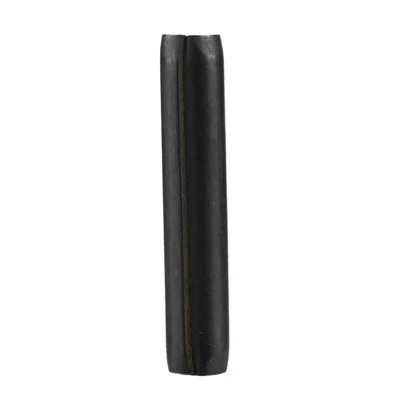

Serrated Spring Pins Specifications
| Parameter | Specification |
|---|---|
| Manufacturing Standards | Q/PES 002 / Q/PES 003 / Enterprise Drawing Standards |
| Diameter Range | Metric 2.0–20.0 mm / Inch 1/16"–3/4" |
| Length Range | 6.0–150.0 mm |
| Material | High-Carbon Spring Steel / Stainless Steel |
| Duty Type | Heavy Duty / Light Duty |
| Design | Slotted Cylindrical Body with Serrated Profile |
| Hardness | Controlled by Material and Heat Treatment Requirements |
| Surface Treatment | Natural Finish + Protective Lubricant / Phosphating / Zinc Plating |
| Customization | Custom Dimensions & Drawing-Based Production Available |
| Packaging | Bulk / Box / Customized Packaging |
The serrated profile is formed along the slotted section of the pin. After insertion, the toothed sections engage the mating hole wall at multiple contact points, increasing mechanical resistance to axial movement. This structure is particularly useful where the assembly requires more positive retention than a conventional smooth slotted spring pin.
- Serrated contact increases localized mechanical engagement with the hole wall.
- Tooth geometry helps resist axial displacement after installation.
- The profile provides additional retention without requiring a separate locking component.

Elastic Compression & Radial Force
The slotted body compresses as the pin passes through the mating hole. Once seated, the spring section attempts to recover its original diameter and maintains outward radial pressure against the hole wall.
Controlled compression reduces the force required for insertion compared with a rigid solid pin of the same interference condition.
Elastic recovery maintains contact pressure after installation.
Radial force allows the pin to accommodate limited variation in the mating-hole diameter while maintaining retention.
Dimensional Tolerance & Hole Fit
The relationship between pin diameter and mating-hole diameter directly affects both installation force and retention. The hole should be machined within the required tolerance and free from excessive burrs or deformation.
Pin diameter is controlled according to the specified product tolerance.
Hole diameter should be selected to provide the required interference without excessive insertion force.
Hole roundness and alignment affect how evenly the pin expands inside the assembly.
Chamfering the hole entrance can help guide the serrated pin during press-fit installation and reduce damage to the slot or teeth.
OEM Manufacturing
Custom Dimensions
Diameter, length, slot dimensions, and serrated profile can be manufactured according to the required assembly specification.
Material & Heat Treatment
Spring steel or stainless steel can be selected according to the required strength, elasticity, corrosion resistance, and hardness.
Surface Treatment
Protective lubricant, phosphating, zinc plating, and other specified finishes are available according to the operating environment.
Drawing-Based Production
Production can follow customer drawings or samples, including dimensional tolerances, inspection requirements, and packaging specifications.
FAQ
What is the main difference between a serrated spring pin and a standard slotted spring pin?
A serrated spring pin has toothed sections along the slot that create additional mechanical engagement with the mating hole. This provides greater resistance to axial movement than a conventional smooth slotted design.
Are serrated spring pins suitable for hinge assemblies?
Yes. They are commonly considered for hinge and pivot connections where the pin needs to remain seated while the joint undergoes repeated movement.
Can the pin be used in a blind hole?
Yes, provided the hole depth is sufficient and the assembly allows the pin to reach its specified seating position. Installation access and removal requirements should also be considered during design.
Does the serrated profile affect insertion equipment?
It can. The tooth geometry may influence insertion force and tooling requirements, particularly in automated assembly. Production trials can be used to determine suitable insertion parameters for a specific assembly.
Hot Tags: serrated spring pins, China serrated spring pins manufacturers, suppliers, factory, Saw Toothed Pins, spring pins, stainless steel roll pins, Stainless Steel Saw Tooth Pins, Toothed Spring Pin, wave spring pin