
Function & Working Principle
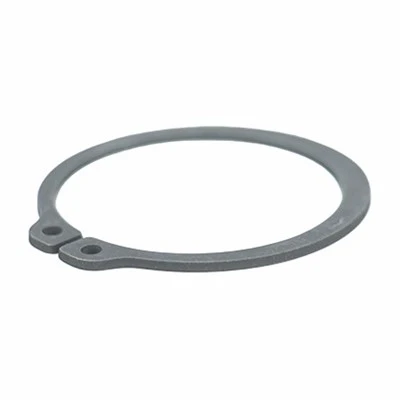
Stainless steel external circlips are mounted into a machined groove on the outer diameter of a shaft to limit axial movement of components such as bearings, gears, or spacers along the shaft.
During installation, the circlip is compressed with circlip pliers and then expands into the groove, where its circular cross-section contacts the groove wall to create radial seating force.
Under rotation or vibration conditions, axial load is transferred through the contact between the circlip and groove shoulder, commonly used with shafts designed to DIN 471 groove dimensions.

Material & Corrosion Resistance
Stainless steel external circlips are typically produced from AISI 304 or AISI 316 wire or strip material, with surface hardness controlled through forming and heat treatment to maintain elastic deformation within shaft groove installations .
In environments with relative humidity above 80% or intermittent water exposure (e.g., gearbox housings, outdoor motor assemblies), the chromium oxide layer on stainless steel provides corrosion resistance by reducing surface oxidation at the contact interface between circlip and shaft groove.
Material selection is based on application load and environment, where 304 stainless steel is used for general mechanical assemblies and 316 stainless steel is selected for chloride-containing environments such as marine equipment or chemical processing systems operating under corrosive media exposure.
Application Fields
Stainless steel external circlips are used on shaft assemblies where axial positioning of components such as bearings, gears, and spacers is required. In automotive transmission systems and industrial gear equipment, they are typically installed in shaft grooves to restrict axial movement under rotating conditions and torque transmission.
In electric motors and general mechanical equipment, circlips are applied on rotor shafts or drive shafts to retain components within defined positions during continuous operation. The selection of stainless steel grades allows use in environments with moisture exposure or moderate temperature variations depending on system design requirements.

Why Choose Us
Stainless steel external circlips are manufactured through controlled forming and stamping processes, with dimensional checks ensuring proper fit into standard shaft grooves such as DIN 471 during installation.
Dimensional inspection is carried out using calipers and go/no-go gauges to confirm that each batch maintains groove compatibility and consistent installation behavior in shaft assemblies.
Installation sampling tests verify that the circlip expands correctly into the groove and transfers axial load under rotating or vibration conditions in mechanical systems such as gear and bearing assemblies.
OEM production is supported by adjusting wire diameter, heat treatment, and free diameter parameters to match different shaft sizes and load requirements in industrial applications.

FAQ
How is the structure different from a retaining nut or shaft shoulder?
A circlip uses a split-ring elastic structure that expands into the groove, while nuts rely on threaded preload and shoulders rely on stepped shaft geometry, which increases machining length and material usage.
What working conditions can it operate under?
In typical industrial applications, stainless steel retaining rings are used in rotating shaft systems; they can withstand operating temperatures exceeding approximately 800°C (depending on the stainless steel grade) and are suitable for environments involving moisture or intermittent water contact, such as motor or gearbox housings.
What are common failure modes in real applications?
Failure can occur due to groove wear, improper groove depth, excessive axial load beyond ring cross-section capacity, or incorrect installation causing incomplete seating in the shaft groove.
How is the circlip integrated into a mechanical system?
The shaft is machined with a standardized groove (e.g., DIN 471), components are assembled onto the shaft, and the circlip is installed using circlip pliers so that it expands into the groove and forms an axial stop behind the assembled parts.
Hot Tags: stainless steel external circlips, China stainless steel external circlips manufacturers, suppliers, factory, 304 stainless steel circlip, 316 stainless steel circlip, Circlip Outer, external circlips, external retaining ring, Stainless Steel External Circlips